
Sunday, September 13th
When I led my first international tour in Bali fifteen years ago, Surya Made and Judy Slattum, our on-the-ground organizers and guides, schooled me on the basics of leading a tour. They let me know that the first and most important thing you have to pay attention to is feeding people before their blood sugar drops and knowing exactly when and where they’ll get to pee. Bathroom stops, meals, and snacks are essential considerations. You must tend to peoples’ basic physical needs before implementing any other aspect of your tour design.
Every group leader has to stay on top of the urination and defecation needs of their group. On our Creative Camino, this is just as true as it was in Bali and on every other trip I’ve led ever since.
When Andre, Brenda and I first got together in Madrid before our first Camino together, Brenda stressed that we always need to pay attention to Maslow’s hierarchy of needs. Bodily needs come first—are you too hot or too cold? Do you have to go to the bathroom? Are you starving or thirsty? Is the sun in your eyes? Is it so loud you can’t hear anything? If these basic physical needs aren’t taken care of, participants can’t focus on anything else. And they certainly can’t think about higher needs, like self-actualization.
This is why in planning our daily route on the Camino, figuring out where sixteen people can pee and poo is to a topic of conversation between Brenda and Andre every single day. The Camino isn’t like hiking in the mountains or on a deep forest trail. You can’t always count on being able to step off the trail to squat and pee. We spend much of our day walking through villages and towns, passing private lands, walking alongside roads and over bridges. For the most part, we are not walking through wilderness. We are walking through farmland, settled land, places where people live. We’re often in public.
Some days, there are multiple public places where we can stop and use the facilities. And some days, there aren’t. Restaurants and stores on the Camino usually mean a bathroom available for pilgrims, but there’s a downside to these stops: every time we pause at a restaurant or store for a bio break, we have to buy something. So, a bathroom stop for couple of people who feel the urge can suddenly lead to half our group taking off their packs (and often their shoes—that would be me!), ordering coffee or something to eat. And since this is Spain, service takes time, and suddenly, two peoples’ need to urinate has turned into an hourlong stop. Not to mention that the coffee people imbibe only necessitates another urination stop a bit further down the road.
If you’re one or two people companionably walking the Way, dealing with physical necessities is easy to negotiate, but traveling with sixteen is a whole other matter because everyone has to pee at different times of the day.
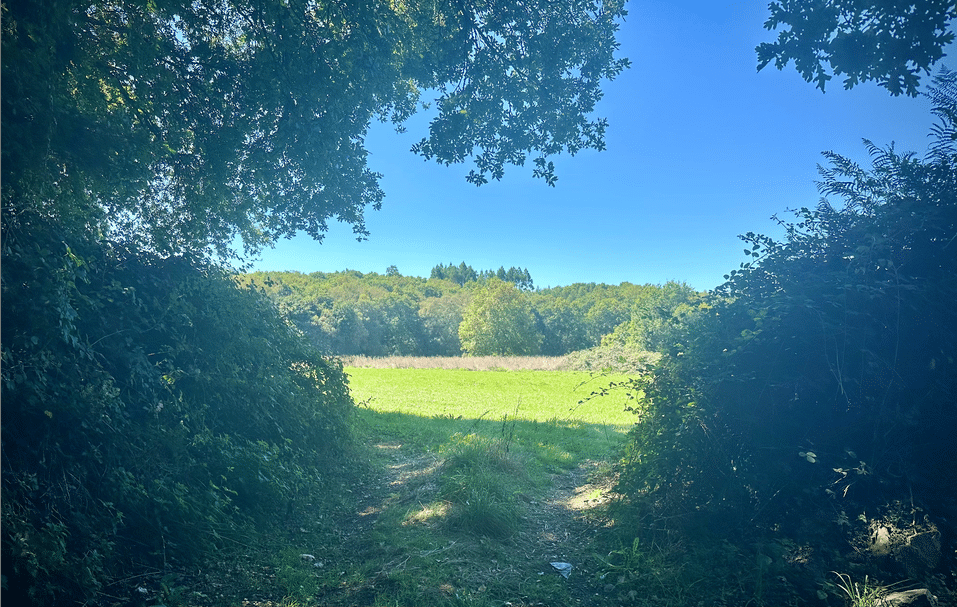
That’s why Brenda talked to us in our orientation about using “the green door.” A green door is place along the trail where a country path leads off the Camino, a place likely to be a good, private spot to squat and pee. Here’s a typical “green door” on the Camino.
In our initial hiking orientation, Brenda handed us each a Ziplock bag, what she called a “green door kit,” with the instruction to carry it with us at all times. The kit contains a packet of tissues (to be replaced with rolled-up toilet paper pilfered from our hotel rooms), a green Ziplock to put soiled tissues in, and the suggestion to add a small bottle of hand sanitizer, an item on our packing list. Brenda’s instructions were to empty the green bag at the end of every day and then to stick it back in the kit to reuse the following day.
The basic principle of elimination while hiking is “Leave No Trace.”
Brenda also told us that when one person needs a green door and several others decide to join her, it’s okay to head into the woods simultaneously, and pee spread out in a line. “We’re all doing the same thing,” she insisted. “No one is looking at each other.” Waiting for sixteen women to take turns peeing in a field as if they’re at the movies waiting for a bathroom stall is an unnecessary waste of time.
So now, when a group of us are hiking together and someone calls out, “I need a green door,” then everybody steps to the side of the path and waits or scrambles up the green door path, because Brenda’s other dictum on the trail is, “Never forego an opportunity to pee.”
An hour later, after walking through a more populous area into a wooded stretch, someone might gesture to a path leading off the trail and call out, “Hey, that looks like a great green door. Anybody need to go?”
As a system for taking care of people’s biological needs, green doors work well and keep our group moving forward. Peeing in the woods or in a field behind a hedge takes a lot less time than stopping to order a coffee or a tortilla (a baked potato/egg pie common to the Camino) or a sandwich for the privilege of using the bathroom.
That doesn’t mean we don’t stop at cafes or restaurants during the day—we do—we just don’t do it every time nature calls.
It also became evident to all of us right away that it’s a good idea to carry your “green door kit” everywhere you go, because there is rarely toilet paper in any of the “official bathrooms that flush” and dripping dry can lead to soggy underwear and ultimately a yeast infection.
There is a modern alternative to the green door kit that I became aware of a few years ago when hiking near the Pacific Crest Trail in Washington. Many of the women, especially young women, we saw hiking on the PCT had these brightly colored fun triangles hanging from their packs. What were they?
I soon found out and order one right away.
Andre and I both brought this new peeing technology with us. There are two brands I’ve used: Kula Cloths and Circe Care. They offer versions of the same product: reusable antimicrobial pee cloths. A toilet paper substitute, these well-designed pee cloths are a perfect companion for hiking, backpacking, camping, trail running, sailing, snowmobiling, and on and on. It’s a way to stay comfortable and have a positive impact on the environment at the same time.
Pee cloths are specially treated squares that snap to your pack using a durable plastic snap. Each pee cloth folds in half and snaps to itself, forming a triangle with the “used side” inside, while featuring a bright, cheerful design on the outside. (If I’ve done a poor job describing it, you can check it out in the picture below.)
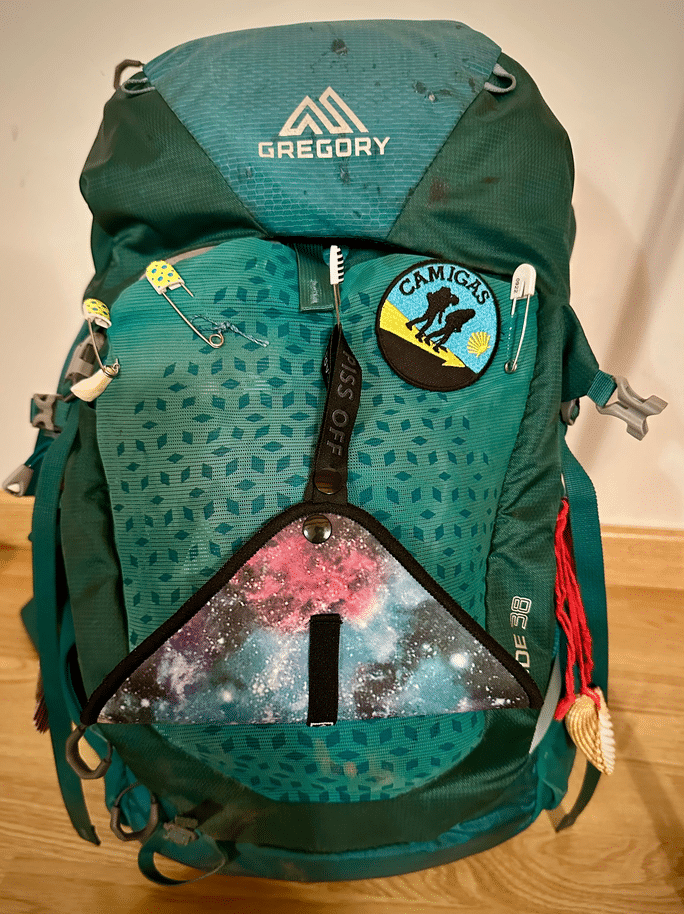
Pee cloths are designed only for pee, not poo, and preclude the need to carry and dispose of toilet paper. You squat, pee, unsnap the triangle, wipe carefully, then resnap the triangle so only the patterned outside shows. There’s a handy cloth handle that keeps you from every getting your fingers soiled or wet. When you’re done, you snap the closed triangle back on your backpack or fanny pack, where it dangles ready for the next green door or bathroom that has no toilet paper. At the end of the day, you rinse out your pee cloth in the sink with a little soap and hang it up to dry, so it’s ready for service the next day.
I carry two, one that stays dry and fresh while the other dangles from my pack, drying.
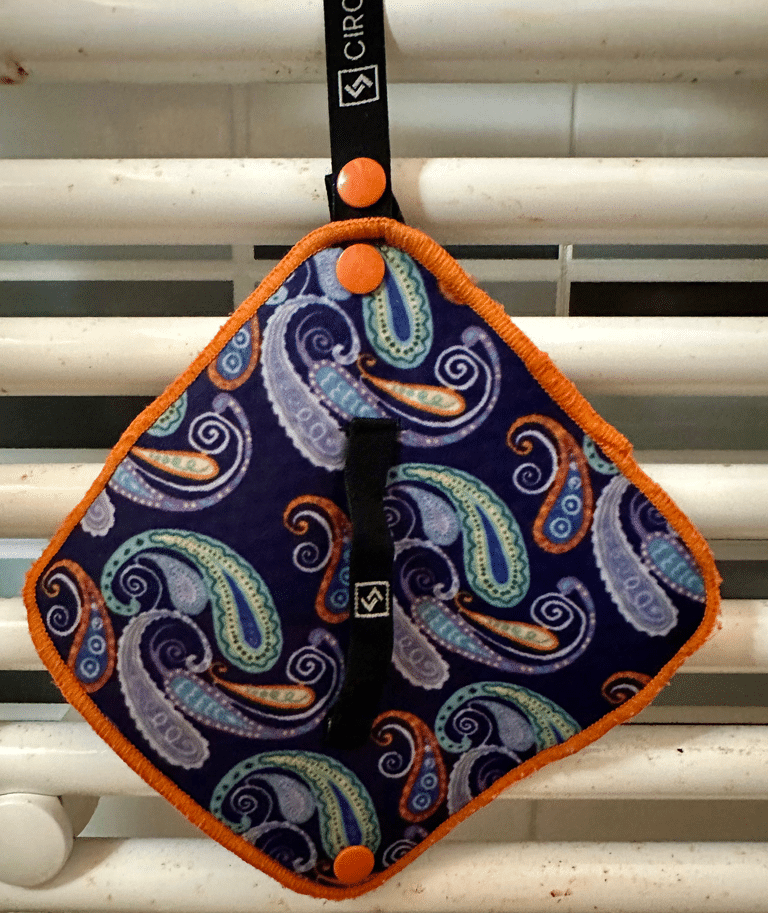
While I’d never think of hanging wads of toilet paper from my pack, I don’t hesitate to showcase my pee cloth. It’s clever, trendy, and cute, something I want to display rather than hide. It signals that I’m a hip, experienced, with-it female hiker. I think it’s fun and very practical. I’ve given them as gifts to lots of women hikers I know.
On this year’s Camino, a couple of people in our group have brought peeing technology to a whole other level. Here’s one of our cohort, trail name Venus, demonstrating a peeing device that enables her to pee standing up like a man. It’s called a pee funnel, otherwise known as a “collapsible female urinal.” Ads tout this portable silicone device as “a game-changer for outdoor adventures and avoiding unsanitary public restrooms.” It allows you to pee discreetly and hygienically and prevents you from peeing on your shoes.
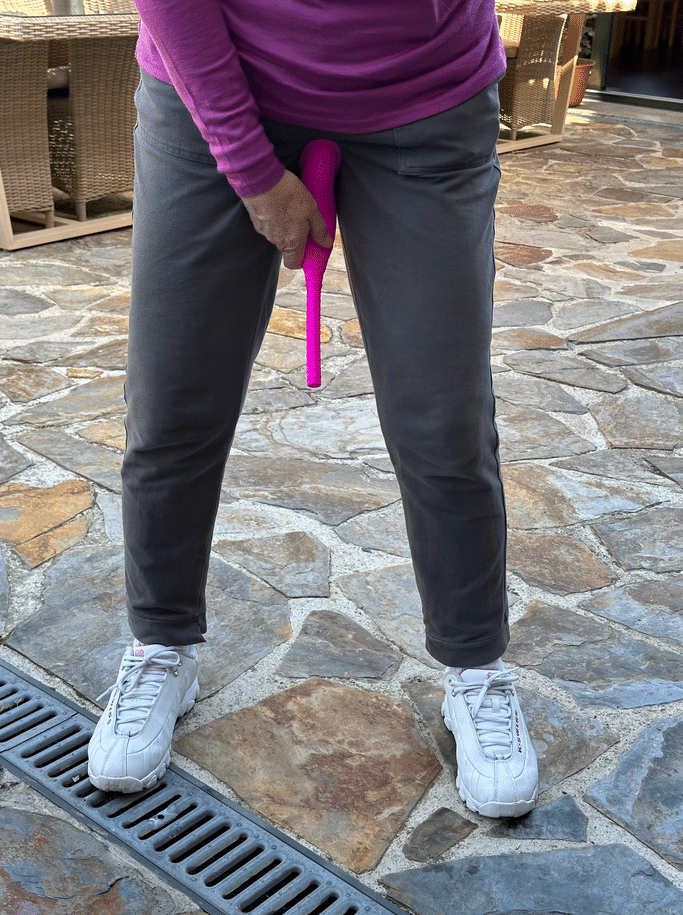
I asked Venus why she brought a pee funnel on the Camino.
She replied, “I always thought it was unfair that men got to pee standing up, so when I first heard about the pee funnel, I got one right away.” Venus tested it out in her bathroom at home before taking it out into the great outdoors, and the design worked great. Her new pee funnel performed as advertised, so her hot pink Sunany pee funnel became one of her “must-have” extras for the Camino.
I asked Venus how she cleans her pee funnel after each use. She said she uses her water bottle or the hose from her water bladder to trickle water inside to rinse it out. Then she folds the pee funnel up and puts it back in its handy case, which she carries on the outside of her pack, “as close to me as possible.”
Aside from the thrill of peeing like a man, Venus says the main benefits for her are not having to fully pull down her pants, not having to crouch down, and the fact that she avoids contamination with poison oak or other irritants her “lady parts” might inadvertently touch.
I asked whether she’d been using her personal urinal on the Camino so far.
“Yes,” she replied, “and yesterday, using it was even more profound. The guys have it so easy. I didn’t have to squat. I didn’t have to pay attention to what was sprouting up in the ground around me.”
Venus let me know that hers wasn’t the only model. There’s also a pee funnel that accordions out and then flattens, expanding into its usable shape as needed.
When I followed up on the Internet, I discovered that there were a variety of different models and designs, with names like Go Girl, the Shewee, and the Tinkle Belle.
What About #2?
After reading all this long post about peeing on the Camino, you may be wondering, “What about #2?” We call that “the brown door.” Of course, it’s best to take care of this need after your morning coffee, before you start hiking or at a lunch stop with an actual toilet, but sometimes you’re hiking in the middle of nowhere and you just can’t wait. It’s a horrible feeling, but when you’ve got to go, you’ve got to go.
Though we try to avoid #2 in public, when it’s unavoidable, the guidelines are to be sure to be away from any water source, to bury it with a bright orange shovel. Andre carries one just for the purpose. And to pack out your toilet paper in a plastic bag. In other words, “Don’t just stick it under a rock.”
“Urgently needing a brown door” has only happened once to someone in our three Camino trips so far, and boy, did that woman look relieved when she came walking back out of the woods.