Wednesday, September 9th
Our departure from Hola Camp Camino was at 7:00 am this morning. We’d learned that there was a big festival going on in O Cebreiro, our next stop. We were getting an early morning start to try to get past the blockades that would be set up to block traffic through the town.
Once we boarded the bus, Andre did a head count three times to make sure we hadn’t left anyone behind. After she nodded in satisfaction, everyone accounted for, Brenda stood up and said in a loud voice, “I want everyone’s full attention.” She waited until she had it before continuing. “Is there any way you can pee now? We really want to be able to ride two hours without stopping.”
A few people stumbled off the bus.
Once bodily functions had been taken care of, Brenda asked, “Do you have your passports? Your wallets? Your glasses? Your phones? Your poles. Every time we have a transition is the time you’re likely to lose something.” Brenda insisted that we all check, so we all did. As I patted my passport and touched my fold up wallet, I gazed the front bus window at a dark sky and gorgeous crescent moon.
I didn’t blame Brenda for making us double-check. So far on this trip, we’ve collectively lost a CPAP machine (yours truly), a pair of glasses, an art kit, and two pairs of hiking poles.
And we are just getting started.
I was determined not to lose anything else. Now, everything I’ve brought with me has its place, and when I use something, I always make sure I put it back in the same spot it came from. But at the same time I’m being mindful of my belongings I am also intentionally leaving things behind. As a solution to burden of my heavy bags, I’ve decided to leave something behind at every stop. At Hola Camp Camino, I gave a bag of almonds to Andre, left behind a scrubby, and ditched box of name tags.
It’s kind of like a game. What can I do without? What can I give away or leave behind?
An hour into our drive, as people began to get hungry, Andre handed out delicious cups full of homemade overnight oats she and Brenda had made from scratch, and a hard-boiled egg for breakfast. The oats were hearty and delicious.
I felt so well taken care of.
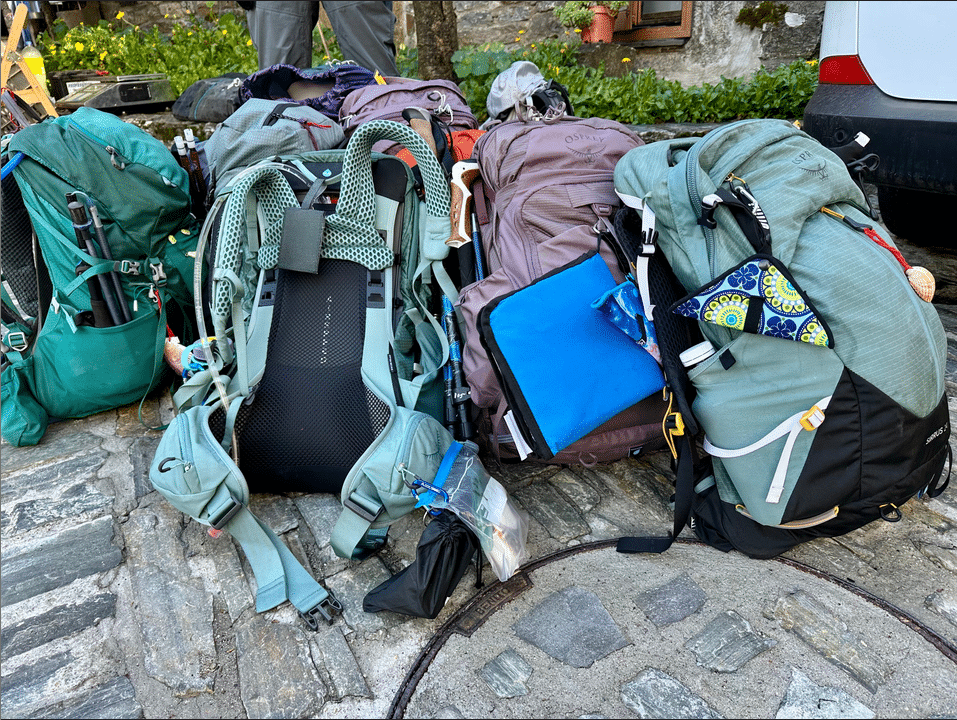
We arrived at the little village of O Cebreiro at nine-thirty am, too late to drive into town before the road closed. So we all lugged our luggage and carried our backpacks several blocks to our hotel. We stashed our luggage inside the hotel (our rooms wouldn’t be ready until afternoon).
We kept our backpacks for a hike out of town.
At 9:43 am, bells started ringing all over town. They went on for a long time. I later found out they were announcing the start of Mass.
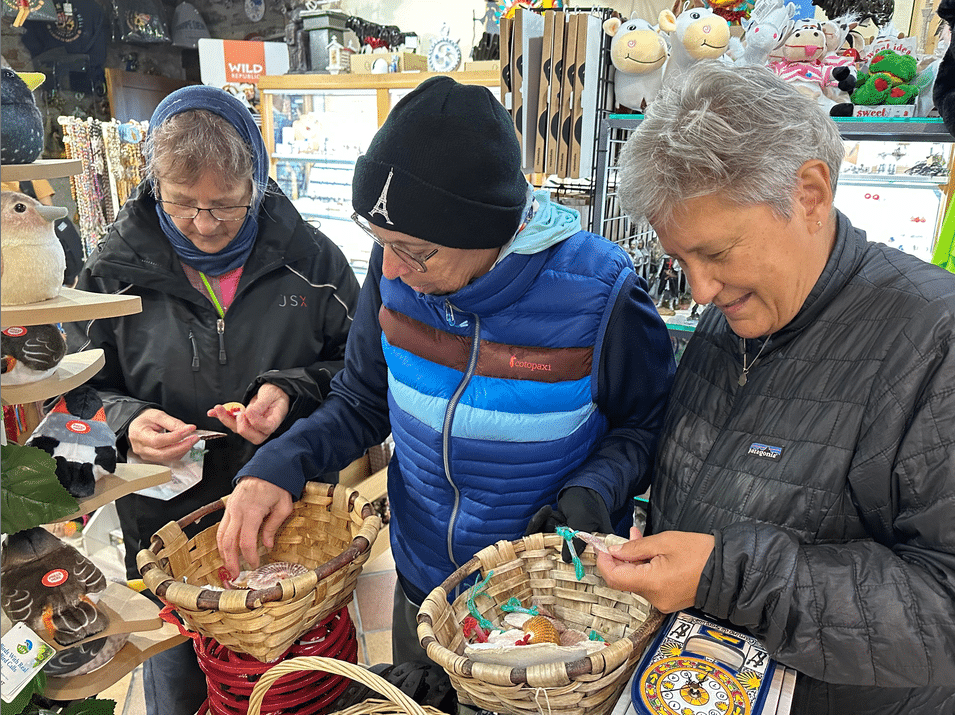
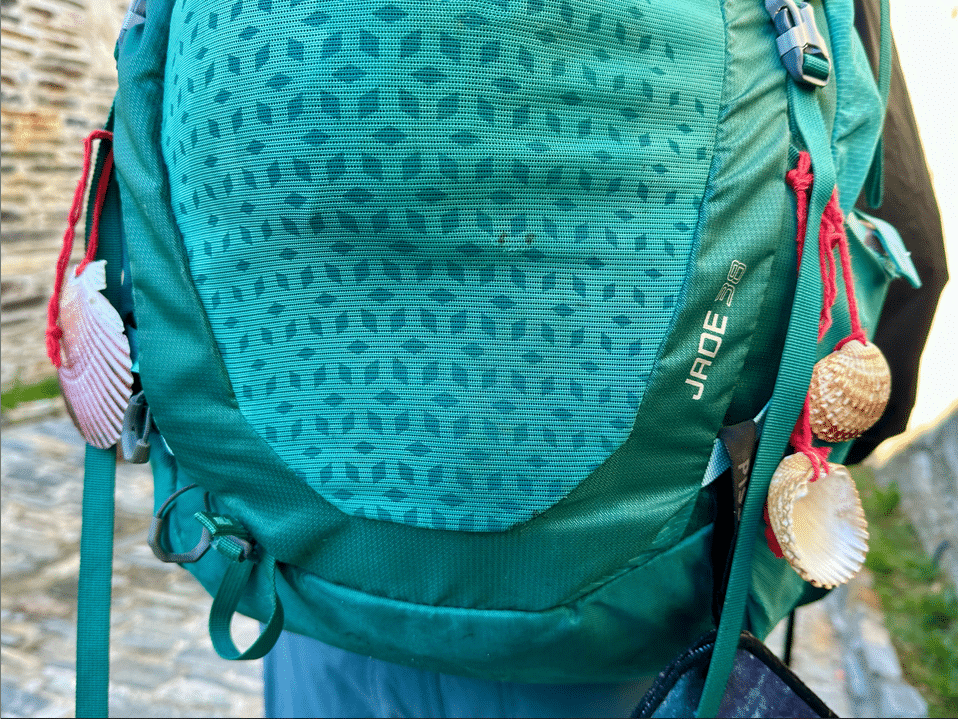
O Cebreiro is the little town where each pilgrim in our group chooses a clamshell to tie on the back of her backpack. Pilgrims on the Camino de Santiago carry a scallop shell on their backpacks as a universal symbol of identification, history, and spiritual connection to the journey.
Just below, you can see three clamshells on the back of my pack; this is my third Camino. I chose a small clamshell today, the one on the upper right, to add to the two already there.
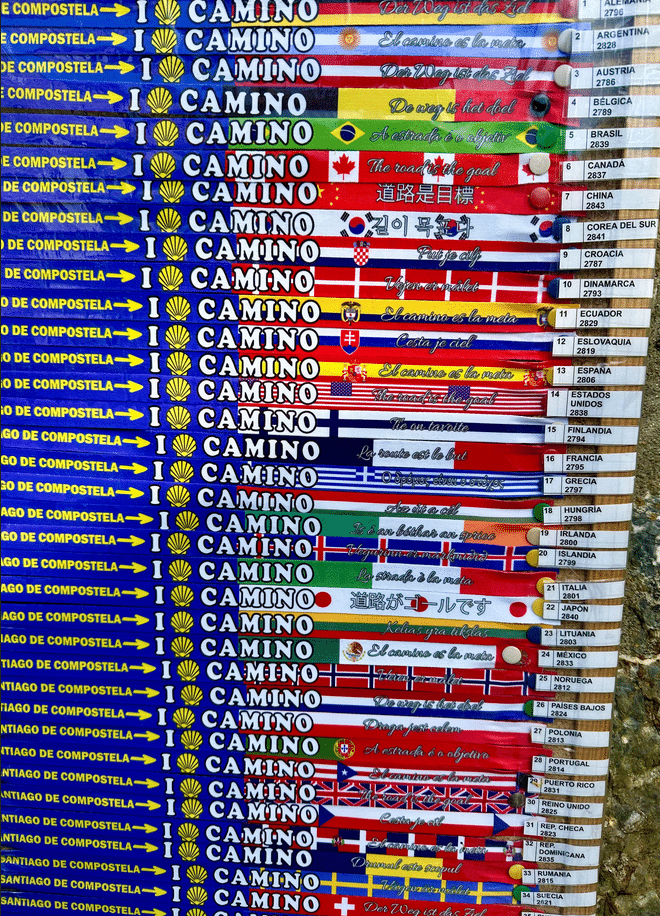
On the wall outside the shop with the clamshells, I noticed this display. Looking at it, you can see that people from all over the world walk the Camino de Santiago.
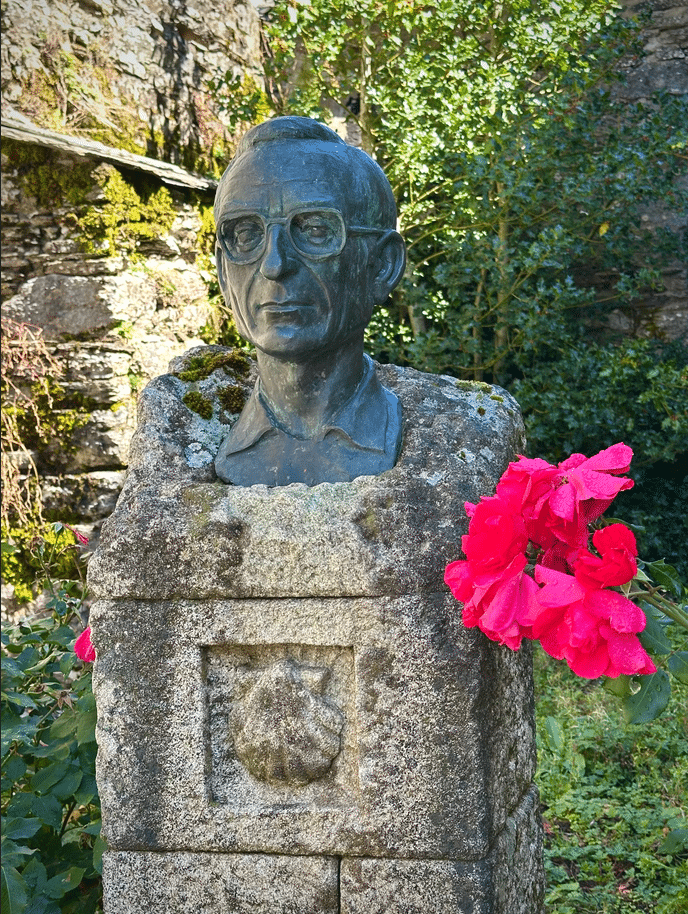
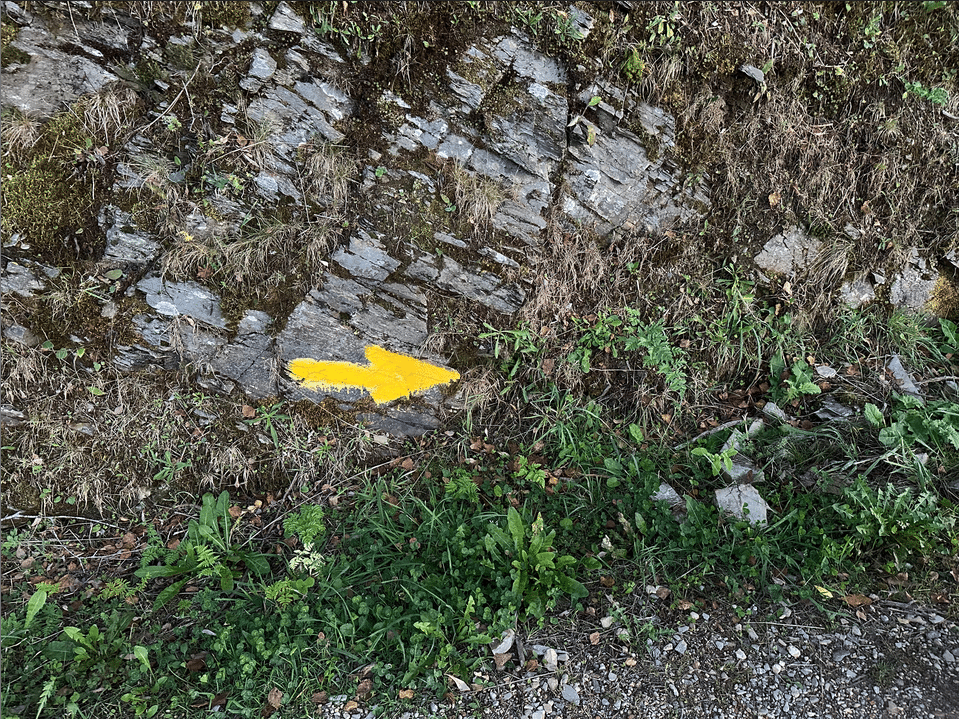
Before leading us out of town for a hike, Brenda and Andre showed us around the town. Beside the church, Andre pointed out a statue of Elías Valiña Sampedro, the parish priest of O Cebreiro who single-handedly resurrected the modern Camino de Santiago by mapping the ancient tracks and painting the iconic yellow arrows from the French border to Santiago de Compostela.
Born in Sarria in 1929, Elías Valiña became the parish priest of O Cebreiro in 1959, where he served the remote mountain village for the next three decades. At the time of his arrival, the village consisted mostly of traditional thatched-roof pallozas without running water or electricity, and his local church was crumbling. He helped revitalize the town and reawakened interest in the ancient pilgrimage trail now known as the Camino de Santiago.
By the 1970s and 1980s, the historic pilgrimage had nearly been forgotten, walked by only a handful of adventurous souls each year. Valiña realized that for the route to thrive again, pilgrims needed to navigate it safely without getting lost in bad weather.
He traveled the entire French Way (Camino Francés) on foot and in his beat-up old car, cross-referencing medieval codices with local landmarks. He cleared overgrown paths, restored historic sites, and established the framework for albergues, modern pilgrim hostels.
In the early 1980s, Valiña began painting simple yellow arrows along the route to guide wayfarers at tricky crossroads. He chose yellow using surplus road paint or taking inspiration from trail-marking conventions he observed in France.
Today, hundreds of thousands of pilgrims travel the French route of the Camino each year.
Here is the man responsible for the renaissance of the Camino de Santiago:
Our three mile hike today was to explore the surrounding area, test out our gear, and practice basic hiking skills before walking more serious mileage tomorrow.
As we stood on the cobblestones with our packs on, waiting for yet another person to return from the bathroom, Brenda talked about the importance of patience and gratitude, and the need to embrace the unexpected. “The Camino provides. It may not provide what you think you need, but it will always provide something.”
Brenda also talked about things we can do while waiting, since waiting is a daily reality on a group trip. People can write in their journals. Or look up and notice the shades of color in their environment, the shapes they see. That led Brenda into an riff on what she was seeing across the road as the morning sun began to rise in the sky. Brenda is the master of teaching on the go!
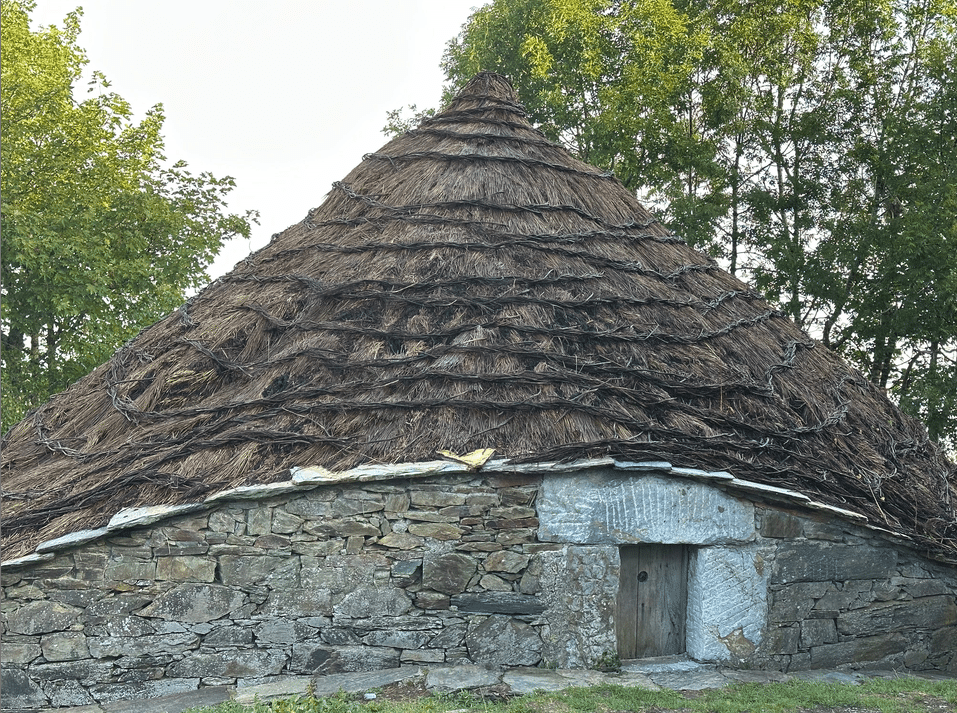
She analyzed the shape of this pallazo with its distinctive conical roof made of rye straw or teito. Built to withstand the harsh, snow-heavy winters of the Galician mountains, pallazos traditionally proved shared space for both human families and livestock to maximize warmth.
But it looked like a hobbit house to me!
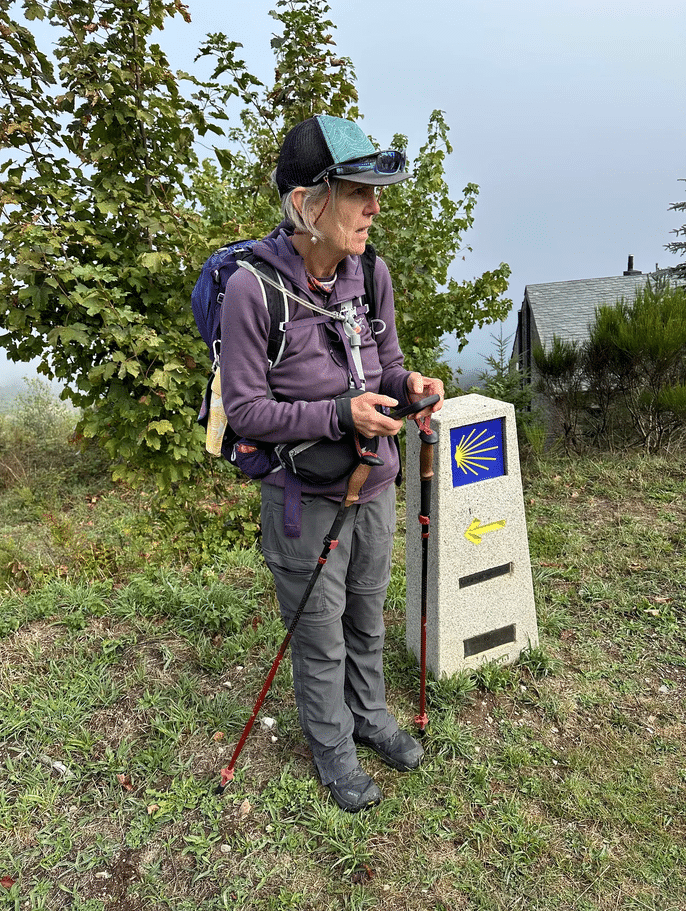
When everyone was finally ready, we walked away from the emerging festival and out of town. Not too far down the road, we came across our first Camino trail marker. In Galicia (the region of Spain we are hiking through), the most common Camino trail markers are made of concrete, and are called mojones. These heavy concrete blocks, placed at regular intervals, embed the yellow arrow next to a ceramic clam shell, and tell Camino pilgrims which direction to go.
Underneath the arrow is a small plaque that shows the distance remaining to Santiago de Compostela. As you get closer to Santiago, the kilometer numbers steadily decrease, all the way down to zero. Watching the numbers count down day by day is one of thrills of hiking the Camino.
This simpler yellow arrow is another kind of Camino marker.
As we walked up and down hills today, Brenda and Andre gave us some basic hiking tips: how to properly use poles going up and down hills, how to walk uphill with a tiny resting step built in so you don’t have to continually stop to catch your breath. As Brenda walked up a hill she said, “On your way up, you use your bones, and on your way down, you use your muscles.”
At the top of a steep incline, we came to this cross, the highest point of the Camino Frances in Galicia.
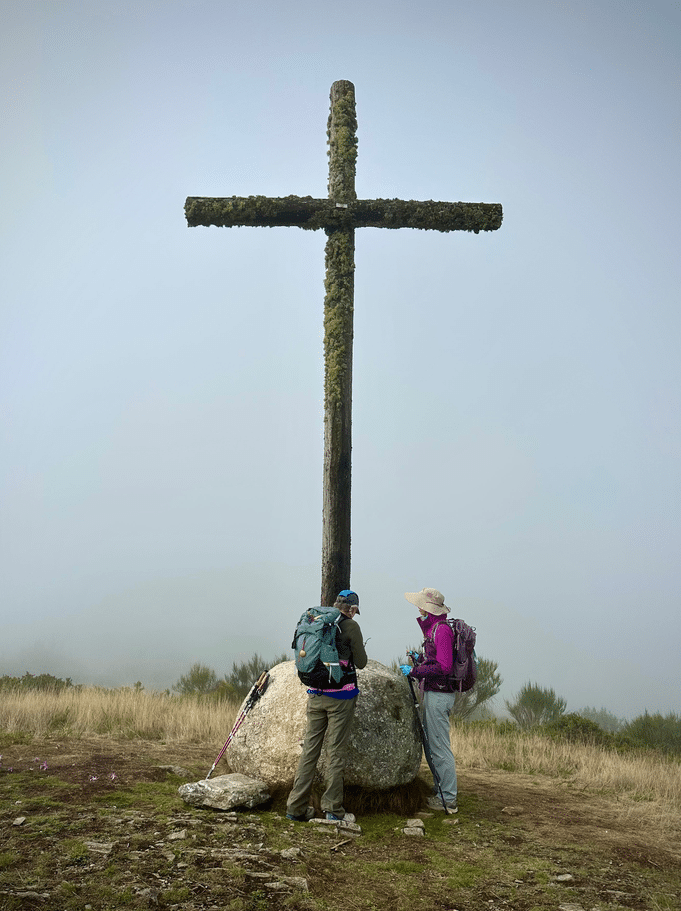
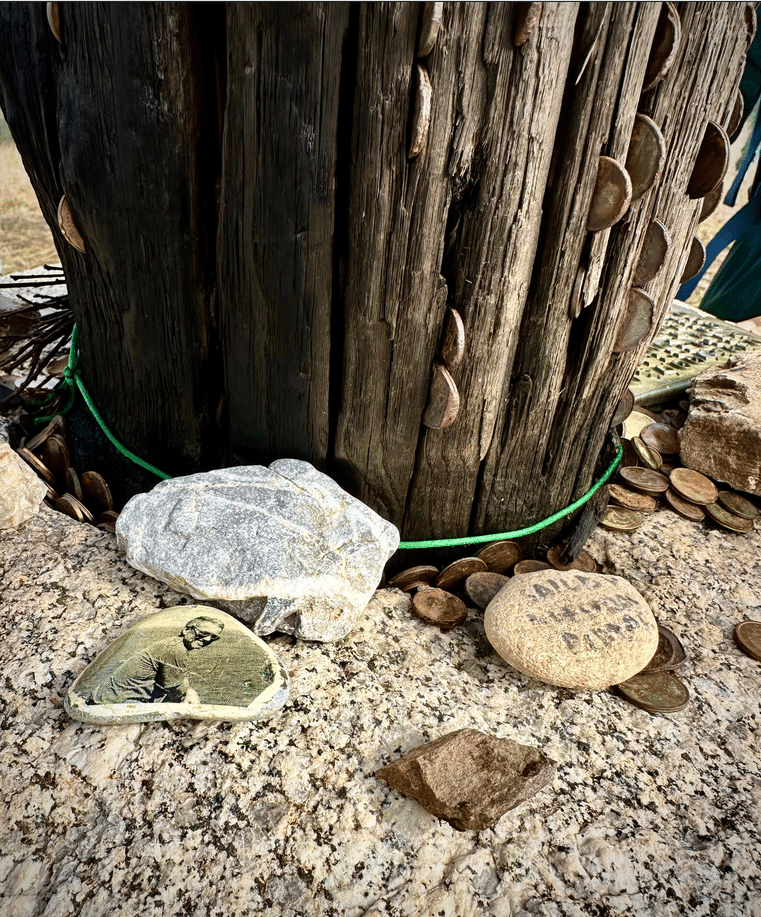
Brenda suggested that we pick up a stone and leave it on the base of this monument in memory of someone close to us who has died or to send prayers to someone who’s ill or struggling. I left a stone for a member of my family facing a terminal diagnosis and said a private blessing. Others left stones as well.
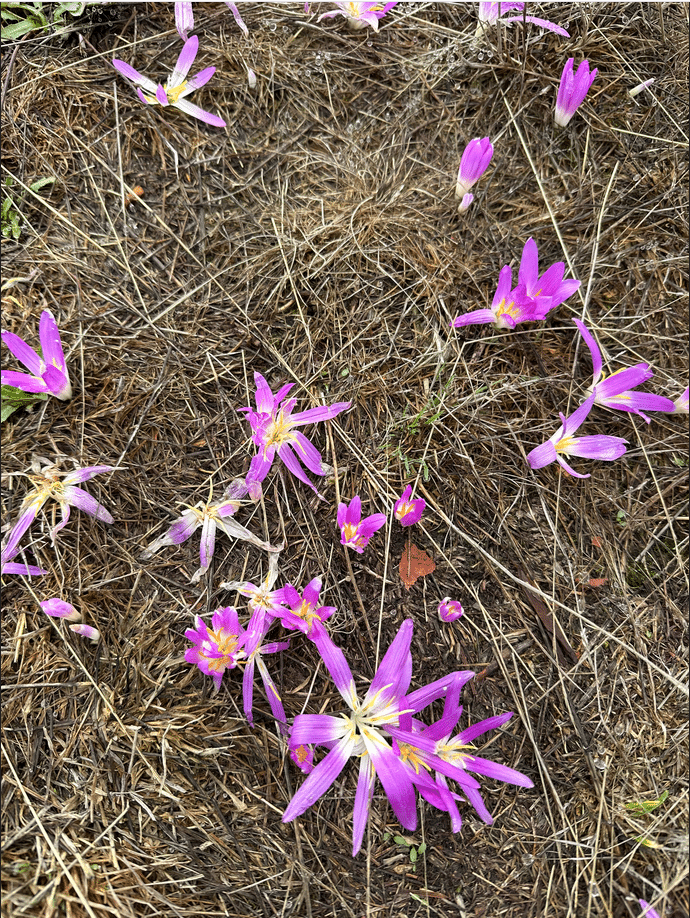
We walked on, admiring the autumn crocuses, growing directly out of the ground.
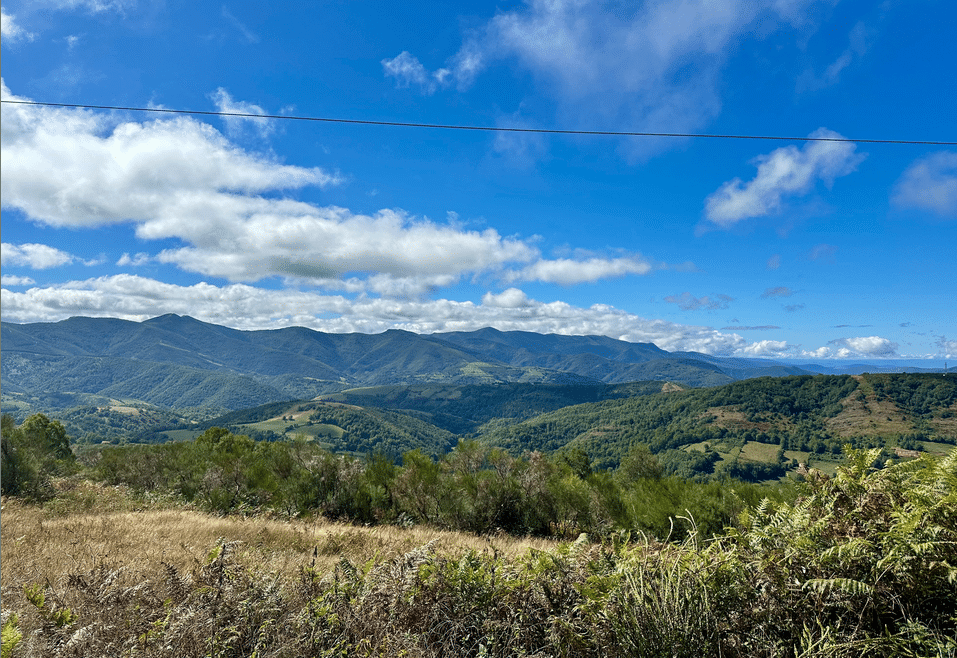
My favorite part of our hike was simply walking. How marvelous to view the world at the speed of our feet. Everything slows down and I notice so much more. Like this fantastic vista:
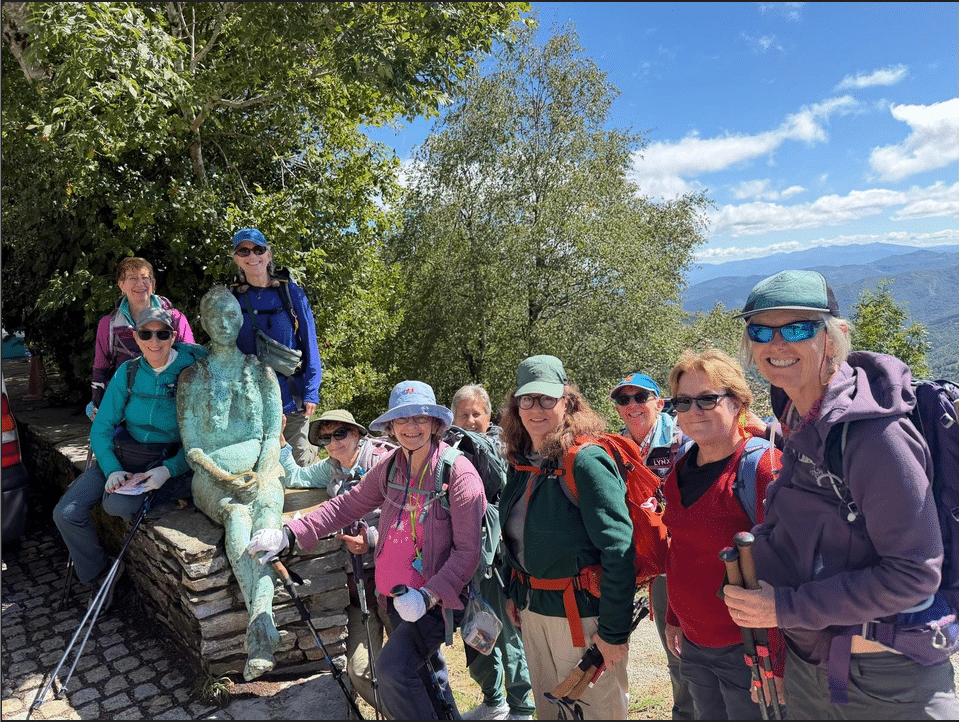
On our way back into town, we communed with this statue:
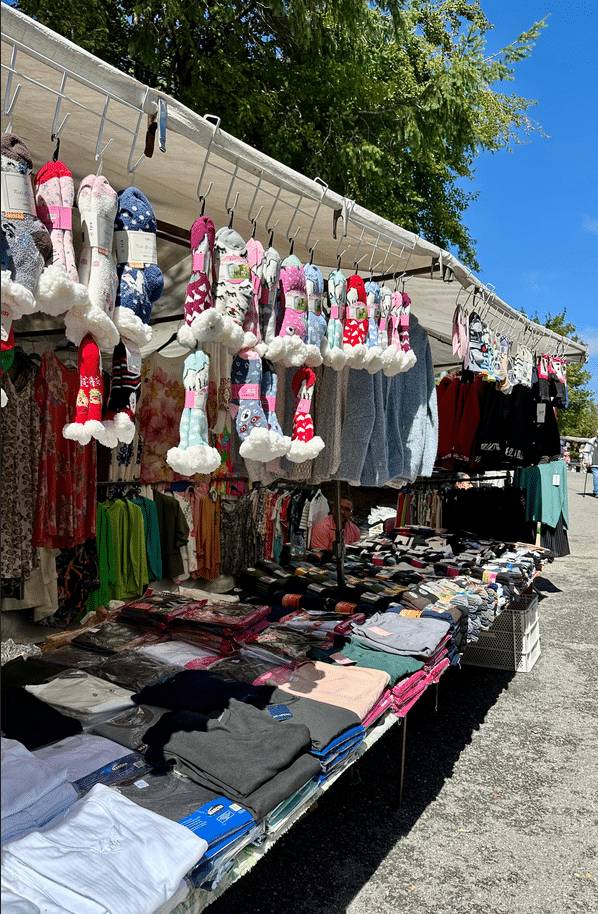
When we got back to town, the fiesta was in full swing. We wandered through a giant open market featuring braids of garlic, soccer shirts, umbrellas, cheap clothes of all varieties, leather belts, Calvin Klein underwear, purses, fleece blankets, straw hats, aprons, boots, shoes, tablecloths, cotton dishtowels, knives, bolts of fabric, bedroom slippers, sundresses. If you needed it, it was probably there.
We passed a beer stand and some food booths. At one, a man rapidly cut up octopus tentacles with a pair of very sharp scissors. At a nearby booth, I bought a fresh loaf of local bread for three euros. My idea was to rip up the giant loaf of bread and hand a chunk to each of our group members. But the bread was so hard, I couldn’t tear it and had to throw it away. I guess it was the thought that counted.
The honey man who raises the bees and extracts the honey had a stand right across from the front door of our hotel.
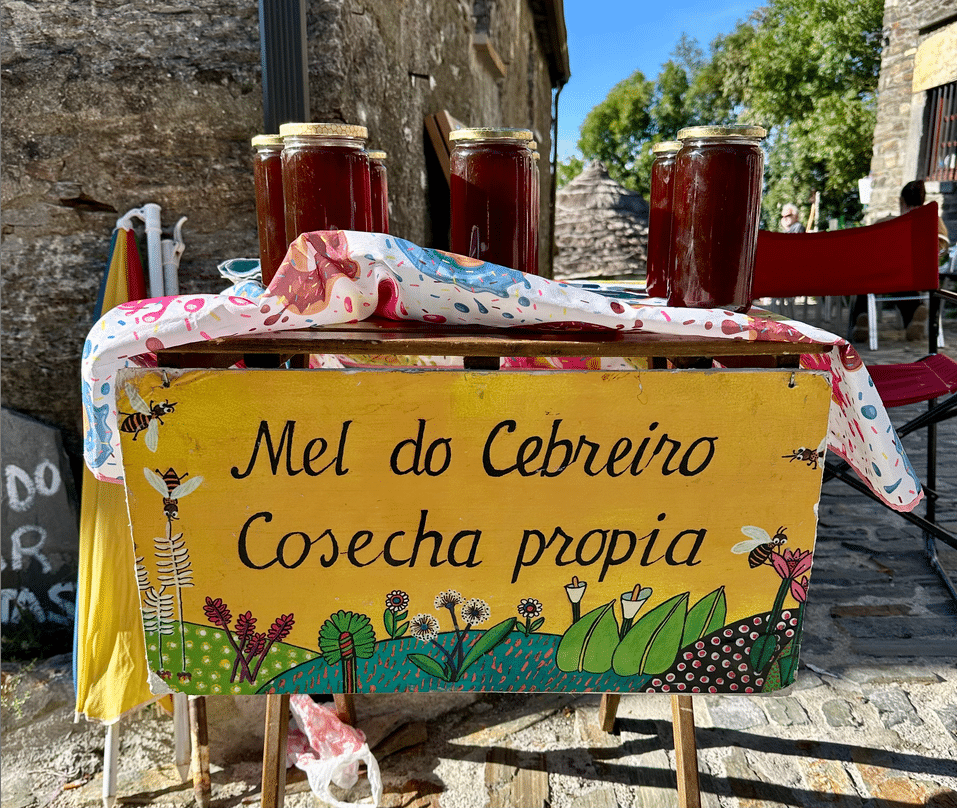
It was quite the celebration.
While Brenda taught an art class, I went to my room, edited my day’s photos, and took a little nap. When I woke up, I walked out into town, and the festivities were reaching their peak. O Cebreiro was crammed with wall to wall people. From what I could tell, they were mostly locals from around the region, lots of them shopping for household goods. I only heard people speaking Spanish.
That, and the tolling of church bells. I followed the bells into the church and for a euro, lit a candle, and said a prayer.
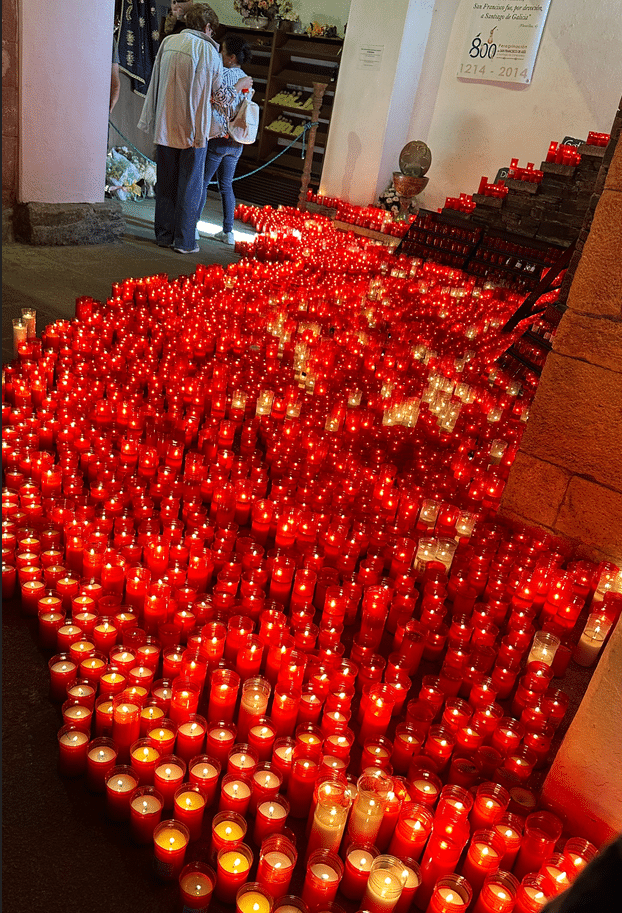
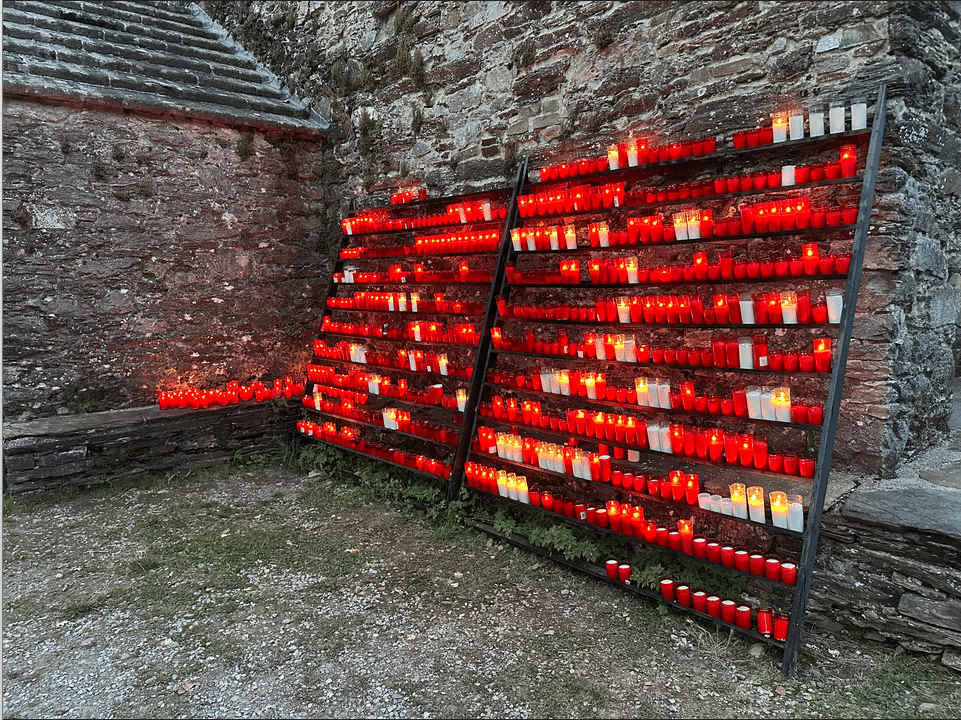
There were more candles outside the church:
After dinner, a few of our pilgrims wandered over to the bandstand and danced.
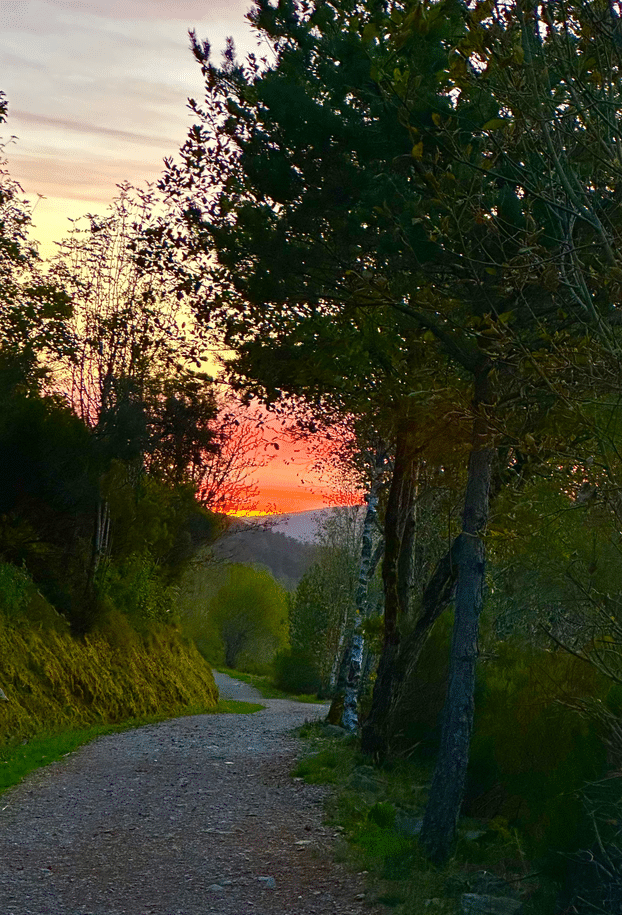
I opted for a quieter evening. Before turning in for the night, I went for a walk up the Camino for half a mile before I turned back. I was rewarded with this beautiful Camino sunset: