Friday, September 11th
Today we had a day for writing, art, laundry, shopping for needed items, and dinner on our own. For our morning writing session, I led a class based on Tim O’Brien’s classic Vietnam novel, “The Things They Carried.” The object of the class was threefold: to learn how powerful objects can be in defining character, to create a braided piece, and to learn to write in layers.
I started class by reading the opening pages of O’Brien’s novel about a platoon of infantry soldiers in Vietnam and what they each carry—weapons, ammunition, love letters, rabbit’s feet, hope, distrust, flak jackets, pictures of girls from back home, belief in God, fear, grenade launchers. O’Brien includes both the physical objects they carry and the less tangible ones, weaving them together brilliantly.
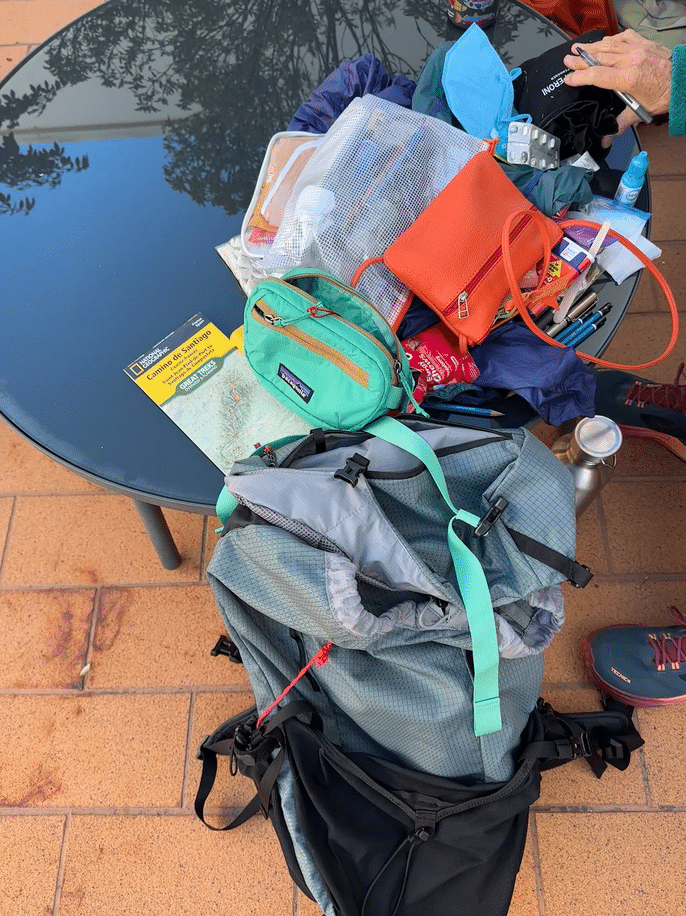
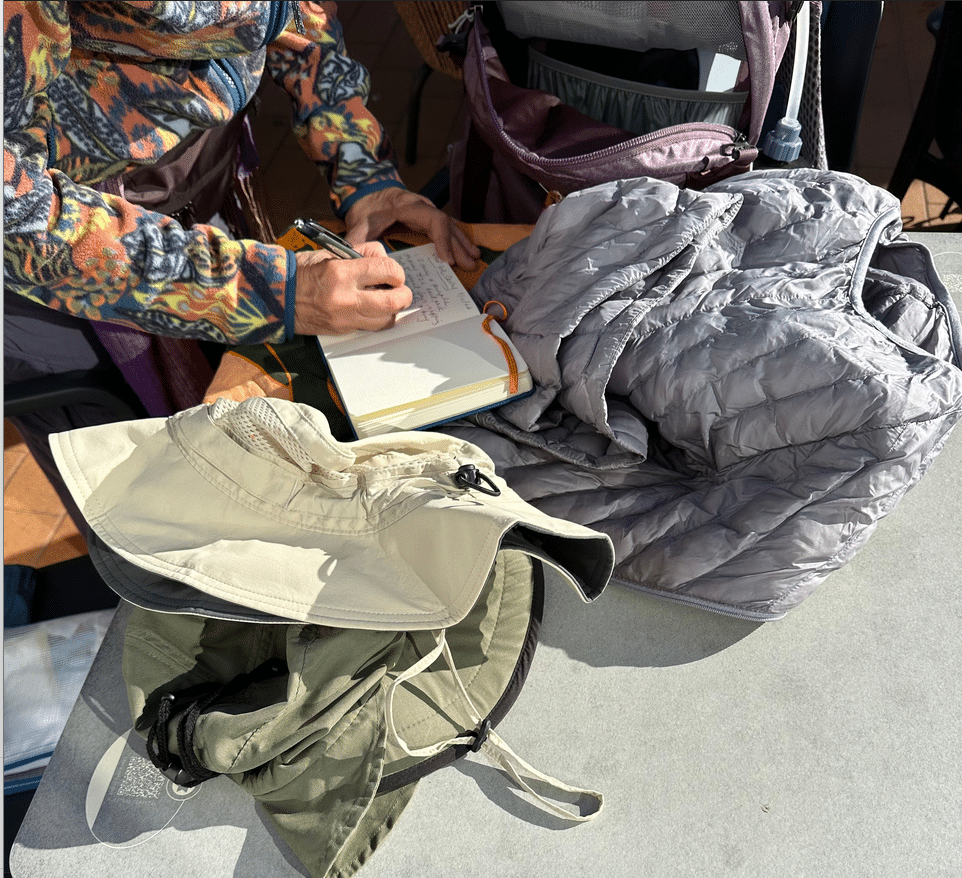
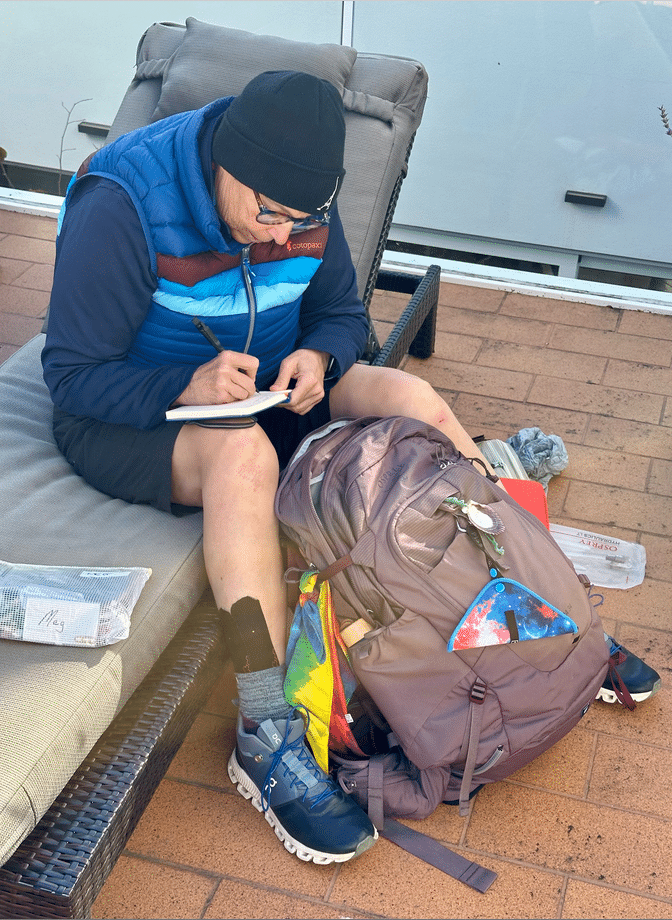
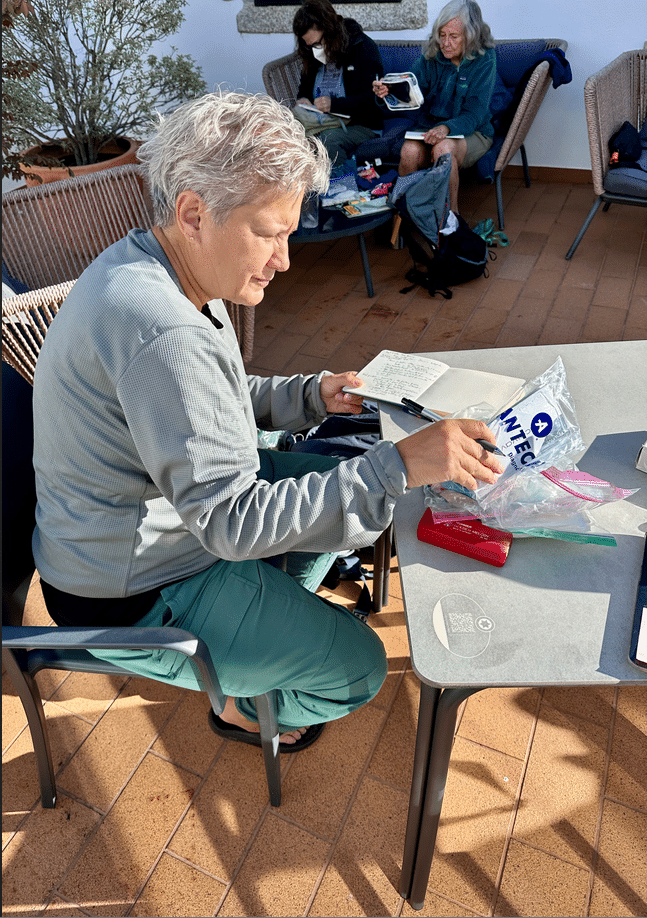
Before class, I had instructed everyone to bring their backpack, fanny pack, and everything they carry on the Camino into our writing room. Once we got there, I told them to lay every item out and to compose a list of all the things they carry, with little descriptions that personalize their lists.
Here’s my list of what I carry, which I read as a sample to my students:
The Things I Carry (version 1):
A green Gregory 36” backpack.
In the main pocket:
- A silky white long-sleeved sun-resistant shirt with a hood.
- A sunhat from REI, the same one Brenda wears.
- A ball cap I can wear under my poncho hood when it’s raining to keep rain off my glasses.
- A black Mysterioso kayaking shirt I’ve had for 30 years that makes me instantly warm when I put it on and is equally insulating when wet as it is when it’s dry.
- A military-designed ultra-thin poncho I bought five years ago in Switzerland, expressly for the Camino.
- An extra pair of wool hiking socks so I can switch them out midday.
- A Nomadix multipurpose camping towel, “The Only Towel You Need,” which doubles as a blanket, a towel, a sit-upon, and picnic blanket.
- 2.5 liters of water in a bladder with the top opening carefully zipped up, shoved into its designated pocket.
- A spare battery for recharging my iPhone.
- A plastic kitchen garbage bag to keep it all dry.
In the outside pockets:
- A pair of collapsible hiking poles with rubber tips, folded in three, wedged in the side pocket.
- A hard plastic quart water bottle covered with decals that represent things I love in life. I use it every day to mix my daily fiber medications and electrolytes (but not at the same time.)
- A tube of HikeGoo to lubricate my feet before I put my socks on to prevent blisters.
- Reef-safe sunscreen.
- A merino wool buff to pull over my neck, ears, and head should conditions get chilly. This might just be my favorite Camino accessory.
- A black cashmere tam to keep my head warm on cold mornings.
- A very thin turquoise windbreaker that folds up into its own pocket.
- A waterproof backpack cover that came with the backpack.
- Thin sun fingerless gloves to protect my hands from chafing from hours using hiking poles.
- Three stones that I will leave in a sacred spot before we reach Santiago: one for me, one my granddaughter asked me to carry, and one for a family member facing terminal illness.
In the top pocket:
- Several plastic bags and a large package of Dude Wipes in case I have an urgent need and can’t make it to a bathroom in time.
- A detailed itinerary of every day of our trip prepared for me as a trip leader.
- A beautiful art kit prepared by Brenda including my Camino journal, paint set, watercolor brush, various pens and pencils, a small ruler and various other art supplies.
On the outside of my pack:
- Four striped diaper pins serving as an impromptu clothesline for my damp hiking socks, still wet from being hand-washed the night before.
- A brightly patterned Piss Off silver-infused pee cloth for women, folded and snapped in a tidy triangle, hanging from a loop in my backpack.
- Three clamshells tied with a red ribbon, symbol of being a pilgrim on the Camino.
- A yellow Camino arrow pin with a rainbow flag background that I bought from a man on the trail who sold it to me for 3 euros.
In my oversize REI fanny pack that Andre insists is too big and too full:
- Two clean bandanas, one for sweat and one for snot. It would be gross to use the same one for both.
- My passport and my wallet with my California driver’s license. Two credit cards. Two bank cards. My Medicare card and supplemental health coverage card. A card from the Neptune Society that says I have prepaid for my cremation and for my body to be shipped home should I die overseas.
- A change purse for Euro coins.
- The little writing notebook I use to record my expenditures and make notes for blogs posts with paper clips to bookmark pages so I can easily go back to them later.
- A gel pen wedged between the pages of said notebook.
- A tiny bottle of hand-sanitizer.
- Electrolyte tablets in a flat packet as well as long skinny packets of electrolyte powder that can be dissolved in my extra water bottle.
- Two round metal tins with snug lids, one for necessary medications, the other for the fiber drink I mix and drink every evening between 5 and 6 pm.
- A K-95 mask for wearing in crowded indoor spaces.
- A Swiss Army knife I brought over in my checked luggage.
- My iPhone and a second spare battery in a plastic ziplock bag.
- An extra pen in case the first one runs out of ink.
- Sunglasses with croakies in a hard plastic turquoise case.
- My pilgrim passport that needs to get stamped twice daily on the Camino.
- Two tubes of lip balm.
- Tylenol in a small flat metal case that screws shut. I used to carry Advil, but due to gut issues, I can’t take ibuprofen anymore.
- A small baggie with essential emergency foot care products that can be accessed on the go.
- A head lamp.
- A pair of Apple airbuds, fully charged. On this trip, I only use them in my hotel room when I’m packing or unpacking.
We shared our lists in small groups and discussed what our lists said about us. I mentioned how we’d all been given the same packing list but were clearly carrying different items. We talked about how some people like to be prepared for anything and others are minimalists. How some of our packs are large and others relatively small. How some people carry extra food and others don’t. How some don’t mind carrying weight and others would rather do without than be burdened by a heavier pack. How some of us have well-organized packs, and know where every item is, while others must pull everything out in order to find the one thing they’re looking for. I emphasized that there wasn’t any right or wrong in these personal preferences. It’s the fact that they are OUR habits is what matters in this exercise.
The point of this exercise was to notice how much the objects we surround ourselves with reveal about our character. And how powerful those details can be in a story. You can learn so much about a person by their choice of things.
In the second half of the class, I talked about the “things we carry” in life that are not physical objects, but rather, pieces of our history, ancestral trauma, responses to injuries, illness and good luck, moments of joy, childhood memories, past experiences, lessons we’ve learned, loved ones dead and alive: all the intangible things we carry that shape who we are and who we’ve become.
I asked them to write a piece describing the more intangible things they carry.
Before I set them loose, I read them an example I’d written to model what I wanted them to do. I hoped my example would lead people into a deeper exploration.
Here’s how my piece began:
The Things I Carry (version 2)
“I carry my twin sister’s beating heart, the heart that only beat when we were one, when we swam in the wet and watery world inside our mother, the heart that was softer, gentler, the heart I urged to stay, the heart that could not stay.
“I carry my grandfather’s hand reaching under the covers to the story about the skunk and a railroad car. I carry the lifesaver, white from a blue pack that he placed on my tongue when he was done.
“I carry my father’s humming tunes, the ones he didn’t even know he was humming, the smell of his body mixed with the oil paints and tempera paints and wood chips and ink of making art with dad in the basement.
“I carry my brother’s stories, Frinkman the superhero emerging from a garbage can to travel to ancient Egypt and Greece, Macedonia and outer space, my brother’s words weaving a web of magic, but only in the car, only outside of New Jersey and New York City.
“I carry my mother’s expectations, the fierce weight of her love, the sound of her voice in the bed in the hospital in the emergency room the week before she died, that sound of bone scraping bone, raw from the marrow of her hip bones, “when will it be over?” I carry the lullabies I sang to her then, songs she’d sung to me when I was a small, songs I’d sung to my children and my grandchildren and when she was dying, sang into her ancient, demented ears.
“I carry with me the desire for a special kind of love, a desire I have carried since the moment I came into this world alone, those weeks I spent in that glass box, untouched except for the tube down my nose, knowing that the one person who could ever really know me and see me and love me was gone, my identical twin whose body that had been wrapped to mine.
“I carry with me the changes age brings and worries about my deteriorating memory.
“I carry the sound of the train whistle my father made when he made sausage fingers, placing his fingers together, intertwined with no air or spaces in between and blowing into the air cavity inside while making a whoo-whoo sound at the same time and there it was, the perfect train whistle, I could smell the diesel and see the smoke when he made that sound and I snuggled closer into his arms.
“I carry with me the thousands of stories that were read to me, the thousands of songs that were sung to me, the thousands of nights I was tucked in with love, the meals that were cooked for me, the food that was always there, the encouragement for me to think and read and write and be, the awareness of the world and its unfairness, but never once the acknowledgement that is was okay to feel.
“I carry with me the driving force of my life to communicate, to speak, to write, to teach, to transform, to inspire, to shock, to influence, to impact, to reach out with words in every form, always going for the heart, the mind, the deepest places I could not yet reach inside myself.
“I carry the words of every student I have ever taught, the rhythm, the cadence, the open hearts, the cracked open battlements, stories pouring out of unexpected places, stories revealing truth in all its myriad permutations.
“I carry shame. I carry fear. I carry joy. I carry lots of worry. I carry momentum, fed to me with my mother’s milk and my oatmeal every morning: do, do, do, this is the way of human life. And I carry my resistance to that lesson. I carry dear friends who love me. I carry a home and the blessings of health and a good constitution. I carry white skin privilege. I carry the ancient history of being a Jew.
“I carry the memory of pushing human beings out of my body and of my more open heart, cracked open by their presence, their need, and their love. I carry the memory of meeting them at airports and dropping them off at airports, saying goodbye with a sinking heart, an empty heart, a full heart….”
And it continued, ending with the line, “And now I carry myself on the Way.”
I sent my students off to write their own version of the things they carry, things that have nothing to do with what’s stowed in their backpacks.
After sharing this second round of writing with dyads, we got back together as a big group and talked about how it felt to write those pieces, and shared takeaways from the assignment.
Before class ended, I gave the group the final step in the exercise as homework: Take the first piece of writing and weave it into the second, joining them together in one braided piece. To alternate the two lists: the one about objects and the one about “life.” I told them they could do it chronologically, randomly, or with conscious intention.
Once again, I read an example from my own work to give them a sense of what this braiding might sound like. Here’s the start of that piece:
The Things I Carry (Version 3: combined)
“On the Camino, I carry a green Gregory 36” backpack. A long sleeve sun-resistant hiking shirt. A sunhat from REI. A black mysterioso kayaking shirt I’ve had for 25 years that makes me instantly warm when I put it on and is equally insulating when wet. A favorite silky blue long sleeve shirt as a medium layer.
“I carry my twin sister’s beating heart, the heart that only beat when we were one, when we swam in the wet and watery world inside our mother, the heart that was softer, gentler, the heart I urged to stay, the heart that could not stay.
“I carry my grandfather’s hand reaching under the covers to the story about the skunk and a railroad car. I carry the lifesaver, white from a blue pack that he placed on my tongue when he was done.
“In the outside pockets: I carry two clean bandanas: one for snot and one for sweat. A pair of collapsible hiking poles with rubber tips, folded in three, wedged in the side pocket. A small water bottle with water and half a packet of electolytes. A one quart hard plastic bottle, decorated with decals, for mixing fiber powder and electrolytes. A tube of HikeGoo to lubricate my feet before I put my socks on to prevent blisters.
“I carry my father’s humming tunes, the ones he didn’t even know he was humming, the smell of his body mixed with the oil paints and tempera paints and wood chips and ink of making art with dad in the basement.
“In the top pocket, I carry a detailed itinerary of every day prepared for me as a trip leader. A beautiful art kit prepared by Brenda including my Camino journal, paint set, watercolor brush, various pens and pencils, a small ruler and various other art supplies.
“I carry my brother’s stories, Frinkman the superhero emerging from a garbage can to travel to ancient Egypt and Greece, Macedonia and outer space, my brother’s words weaving a web of magic, but only in the car, only outside of New Jersey and New York City.
“I carry my mother’s expectations, the fierce weight of her love, the sound of her voice in the bed in the hospital in the emergency room, that sound of bone scraping on bone, raw and from the marrow of her hip bones, when will it be over? I carry the lullabies I sang to her then, my voice right into her pocket talker, songs she’d sung to me when I was a small, songs I’d sung to my children and my grandchildren and now into her ancient, demented ears.
“On the outside of my pack, I four striped diaper pins serving as an impromptu clothesline for my damp hiking socks, still wet from being hand-washed the night before. A brightly patterned Piss Off silver-infused pee cloth for women, folded and snapped in a tidy triangle, hanging from a loop in my backpack. And three clamshells tied with a red ribbon, symbol of being a pilgrim on the Camino, two from past Caminos and one for this year.
“I carry with me the desire for love, a desire I have carried since the moment I came into this world alone, those weeks I spent in that glass box, untouched except for the tube down my nose, knowing that the one person who could ever really know me and see me and love me was gone, the identical twin whose body that had been wrapped to mine.”
And so on…
Now, they have a couple of days to work on these pieces and when we have our next non-walking “creativity” day, we’ll circle up and see what they came up with.
It was a great class. I love teaching writing on the Camino—even though the classes are less frequent than at a “normal” writing retreat, our sessions still weave the group into a deeper, more intimate connection.
Buen Camino!
PS. Here are pictures of some of the things we carry. And the process of my students recording them.